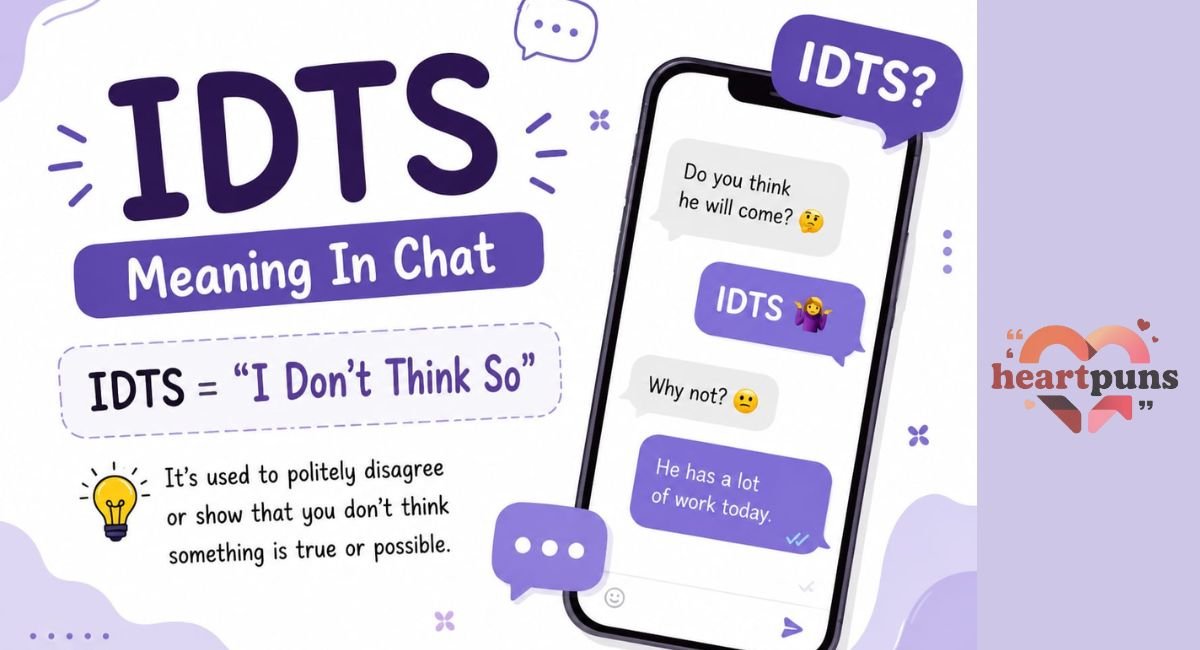

Ever received a text that said “IDTS” and stared at your screen like your phone had started speaking in code? 😄 Don’t worry, you’re definitely not alone. The IDTS meaning in chat is actually pretty simple: it usually stands for “I Don’t Think So.” This popular texting abbreviation is often used when someone expresses doubt, disagreement, or uncertainty in a casual conversation.
If you’re wondering what does IDTS mean in text, you’ll usually find it in quick replies, group chats, social media comments, and everyday messages. The fun part is that its tone can change with the situation. Sometimes IDTS sounds playful, sometimes doubtful, and sometimes like a tiny “nope” wearing sunglasses. 😎
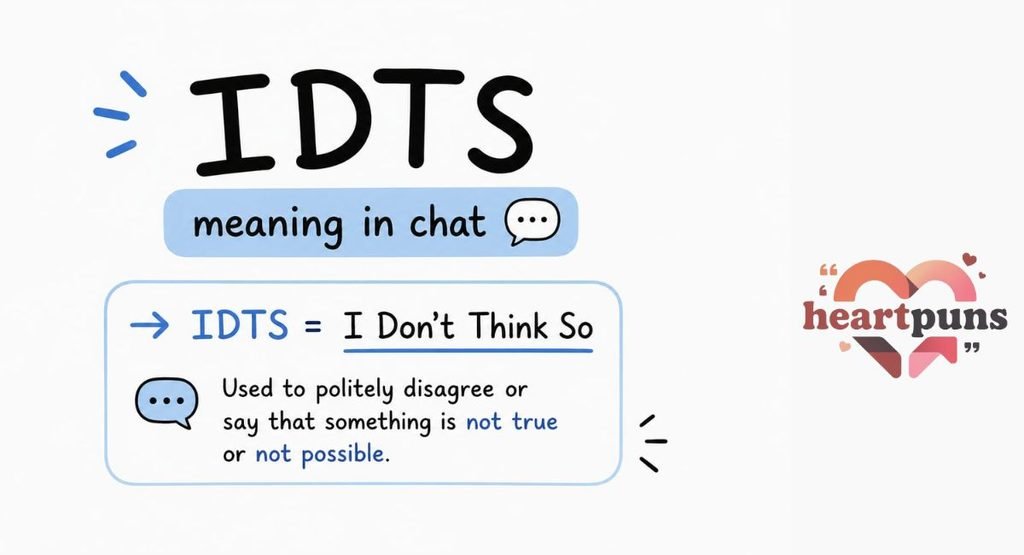
IDTS Meaning in Chat
IDTS most commonly means “I Don’t Think So.”
It is a casual text slang abbreviation used to express doubt, disagreement, or uncertainty. Instead of typing the complete phrase, someone can simply write “IDTS” to give a quick response.
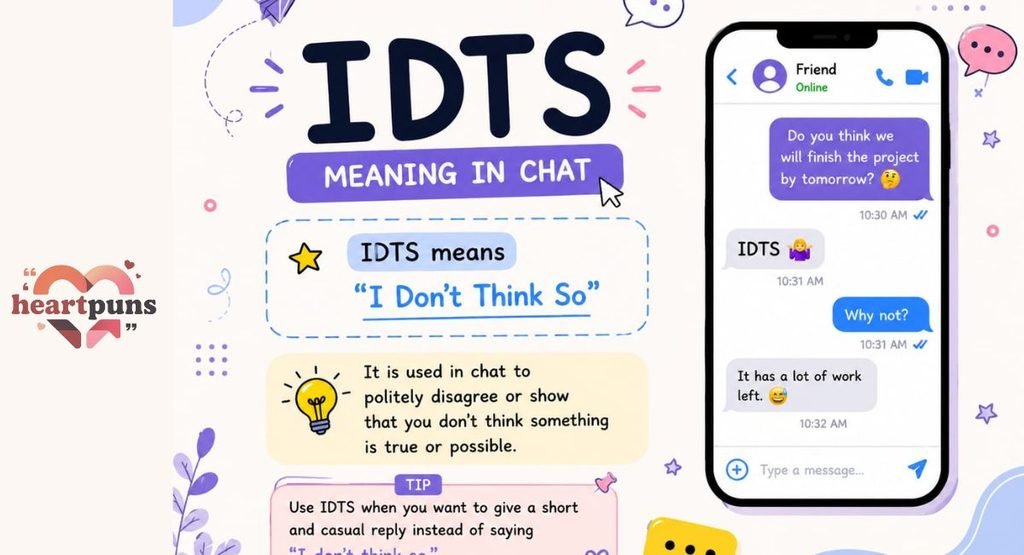
For example:
Friend: “Do you think Jake is coming tonight?”
Reply: “IDTS, he said he was busy.”
Here, IDTS means “I don’t think so.” The person is sharing a personal opinion rather than stating an absolute fact.
The abbreviation works especially well in casual messaging because it saves typing effort while keeping the conversation moving.
IDTS Meaning in Texting
The IDTS meaning in texting is generally connected with doubt or mild disagreement.
Someone may use it when responding to a question, prediction, suggestion, or statement. It can also soften a disagreement because “I don’t think so” usually sounds less direct than saying “No” or “That’s wrong.”
For example:
Friend: “The store closes at 7, right?”
You: “IDTS, I think it closes at 9.”
Or:
Friend: “We can finish everything in an hour.”
You: “IDTS lol.”
In both examples, IDTS expresses a different opinion without necessarily creating an argument.
This makes it a useful part of casual digital communication and everyday text conversations.
Why People Use IDTS
There are several simple reasons people use IDTS instead of writing the full phrase.
First, it is quick. Short abbreviations make it easier to send quick replies when someone is chatting from a phone.
Second, IDTS fits the relaxed communication style of texting and social media.
Third, it can make disagreement sound softer. Saying “IDTS” can feel less confrontational than directly saying, “You are wrong.”
For example:
Direct: “No, that won’t work.”
Softer: “IDTS, maybe we should try another idea.”
This is why IDTS can work as a casual disagreement marker or even a small disagreement buffer.
IDTS Tone and Vibe
The meaning of IDTS is usually straightforward, but its tone and context can change how it feels.
A friendly message might make IDTS sound playful:
“IDTS 😂 you’re definitely going to change your mind.”
A neutral message may simply express an opinion:
“IDTS, I think the shop is closed.”
A short response can sometimes feel dismissive:
“IDTS.”
That difference comes from the surrounding conversation, punctuation, emojis, and relationship between the people chatting.
Friendly Tone
“IDTS haha, but you might be right.”
This sounds relaxed and open to discussion.
Neutral Tone
“IDTS. The website says it starts tomorrow.”
This simply gives another viewpoint.
Dismissive Tone
“IDTS, whatever.”
Here, the additional wording makes the response feel colder.
So, IDTS depends on context. The letters themselves are not automatically rude or friendly.
Funny IDTS Examples in Everyday Chats
Sometimes IDTS becomes funny because of the situation around it. Here are some original examples you might see in everyday casual conversation.
Example 1: Weekend Plans
Friend: “Are we actually waking up at 6 AM?”
You: “IDTS 😂.”
Example 2: Food
Friend: “You said you were only ordering one pizza.”
You: “IDTS, that was before I saw the menu.”
Example 3: School
Friend: “I can study the whole chapter in 20 minutes.”
You: “IDTS 😭.”
Example 4: Dating
Friend: “Do you think they’re going to text first?”
You: “IDTS, but let’s see.”
Example 5: Gaming
Player: “This strategy will definitely win.”
Reply: “IDTS bro, they already figured it out.”
These examples show how IDTS can express doubt, skepticism, or playful disagreement without turning the conversation into something serious.
IDTS in Social Media Chats
The IDTS meaning on social media remains “I Don’t Think So.”
People may use it in comments, direct messages, group discussions, and replies. It can be especially useful when reacting quickly to predictions or opinions.
IDTS Meaning on Snapchat
On Snapchat, IDTS can appear in short conversations between friends.
Friend: “Do you think she saw my snap?”
Reply: “IDTS.”
The sender is simply saying, “I don’t think so.”
IDTS Meaning on TikTok
The IDTS meaning on TikTok can appear in comments when someone disagrees with a claim or prediction.
Comment: “This is definitely the best movie ever.”
Reply: “IDTS 😂.”
The response shows a casual difference of opinion.
IDTS Meaning on Instagram
On Instagram, people may use IDTS in DMs or comment replies.
Friend: “Do you think this rumor is true?”
Reply: “IDTS tbh.”
Here, “tbh” adds “to be honest” and makes the response feel more like a personal opinion.
IDTS Meaning on Discord
In Discord conversations, IDTS can be useful for quick reactions during discussions or gaming chats.
Player: “We should attack from the left.”
Reply: “IDTS, they’re already covering that side.”
The abbreviation helps maintain conversational flow during a fast discussion.
IDTS vs. IDT and IDK
Texting abbreviations can look surprisingly similar, so it is easy to confuse IDTS with IDT or IDK.
| Abbreviation | Meaning | Typical Use |
| IDTS | I Don’t Think So | Doubt or disagreement |
| IDT | I Don’t Think | Expressing a thought or uncertainty |
| IDK | I Don’t Know | Lack of knowledge |
| IMO | In My Opinion | Giving a personal opinion |
IDTS vs. IDT
IDTS is the complete casual phrase “I Don’t Think So.”
Example:
“Will he come?”
“IDTS.”
IDT usually means “I Don’t Think” and may need additional words.
Example:
“IDT he will come.”
IDTS vs. IDK
IDTS expresses doubt about something.
“IDTS that’s true.”
IDK means the person does not know.
“IDK if that’s true.”
The difference is small but important. One expresses an opinion or belief, while the other expresses a lack of information.
IDTS vs. IMO
IMO means “In My Opinion.” It introduces a personal viewpoint.
IDTS, meanwhile, usually signals that the person does not agree with or believe something.
IDTS in Everyday Conversations
You can find IDTS in many forms of informal communication.
IDTS for Plans and Decisions
Friend: “Should we leave at 5?”
Reply: “IDTS, traffic will be crazy.”
IDTS When Declining Plans
Friend: “Can you come tonight?”
Reply: “IDTS, I have work.”
IDTS When Responding to Questions
Friend: “Do you think the exam will be easy?”
Reply: “IDTS 😅.”
IDTS When Responding to Claims
Friend: “He already finished the project.”
Reply: “IDTS, he was still working on it earlier.”
IDTS When Discussing Rumors
Friend: “I heard they’re moving away.”
Reply: “IDTS, I saw them yesterday.”
In each case, the abbreviation keeps the conversation short while showing the sender’s current opinion.
When IDTS Sounds Funny or Dismissive
One interesting thing about texting slang is that a very short message can carry a surprisingly strong personality.
“IDTS 😂” can sound playful.
“IDTS tbh” can sound honest.
“IDTS…” may sound doubtful or hesitant.
“IDTS.” can feel blunt, especially when the previous message was serious.
For example:
Person: “I worked really hard on this idea. Do you think it’s good?”
Reply: “IDTS.”
That response could easily feel harsh because there is no explanation or friendly context.
A better response might be:
“IDTS tbh, but I think you could improve the ending.”
The second version still communicates disagreement but adds a helpful explanation.
This is why IDTS tone and vibe depend heavily on the relationship, situation, and surrounding words.
How to Respond to IDTS
If someone sends you IDTS, your response depends on the situation.
Casual Replies
- “Maybe you’re right.”
- “Fair enough 😂.”
- “We’ll see.”
- “Why not?”
- “I guess we’ll find out.”
Friendly Replies
- “Really? Why do you think that?”
- “Haha, you might be right.”
- “What makes you say that?”
Mature or Respectful Replies
- “I see your point. Can you explain?”
- “That’s fair. I hadn’t thought about it that way.”
- “I understand why you disagree.”
If the conversation is serious, a complete sentence is often better than responding with another abbreviation.
When to Use and Avoid IDTS
IDTS is best suited to informal communication.
When to Use IDTS
You can comfortably use it in:
- Casual text messages
- Conversations with friends
- Group chats
- Social media comments
- Instagram DMs
- Snapchat conversations
- TikTok replies
- Discord communities
- Gaming chats
- Informal online conversations
For example:
“Think they’ll win?”
“IDTS lol.”
That feels natural in a casual setting.
When to Avoid IDTS
Avoid using IDTS in situations where clear and professional language is expected.
These include:
- Professional emails
- Formal discussions
- School assignments
- Business documents
- Official reports
- Important workplace communication
Instead of:
“IDTS this plan will work.”
A professional alternative would be:
“I don’t think this plan will work as proposed.”
Other formal alternatives include:
- “I’m not sure that is correct.”
- “I don’t believe that will happen.”
- “I have some concerns about that idea.”
- “I’m not convinced that approach will work.”
FAQ
What does IDTS mean in text?
IDTS usually means “I Don’t Think So.” It is a casual texting abbreviation used to express doubt, uncertainty, or mild disagreement in messages and online conversations.
What does IDTS mean in Gen Z?
Among Gen Z users, IDTS generally means “I Don’t Think So.” It is commonly used in casual chats, social media comments, and quick replies when someone doubts a statement or prediction.
What does LDTS stand for in slang?
LDTS does not have one widely accepted slang meaning. Its interpretation can depend on the conversation or online community where it appears. If you see LDTS in a message, check the surrounding context before assuming what it means.
What to reply to IDTS?
Your reply depends on the tone of the conversation. You could say “Why do you think so?”, “Maybe you’re right,” “Fair enough,” or “We’ll see!” For a playful chat, adding an emoji can make your response feel friendlier.
How do I abbreviate “I don’t think so”?
The most common abbreviation is IDTS, which stands for “I Don’t Think So.” It is mainly used in casual text messages, group chats, social media, and other informal online conversations.
Conclusion:
The IDTS meaning in chat is simple: “I Don’t Think So.” This handy texting abbreviation helps people express doubt, hesitation, or mild disagreement without typing a full sentence. You may see IDTS in text messages, group chats, social media comments, and casual online conversations. Its tone can be friendly, playful, neutral, or slightly dismissive depending on the context, so always consider the conversation before judging its meaning.
Once you understand how IDTS is used, it becomes much easier to follow modern texting slang. Whether someone sends “IDTS 😂” or simply “IDTS,” the message usually shares a quick opinion. Just remember to keep it for casual communication and use clearer language in professional or formal situations.
| Discover More |
| “Love isn’t always emotional—sometimes it’s funny too. Discover HeartPuns.” |
| “For deeper feelings, check HindipoetryHub.” |
| “If these words touched your heart, Captions will make you smile. |
| “If you enjoyed these blessings, you might also like Wishes at MyblessingDiary.” |

