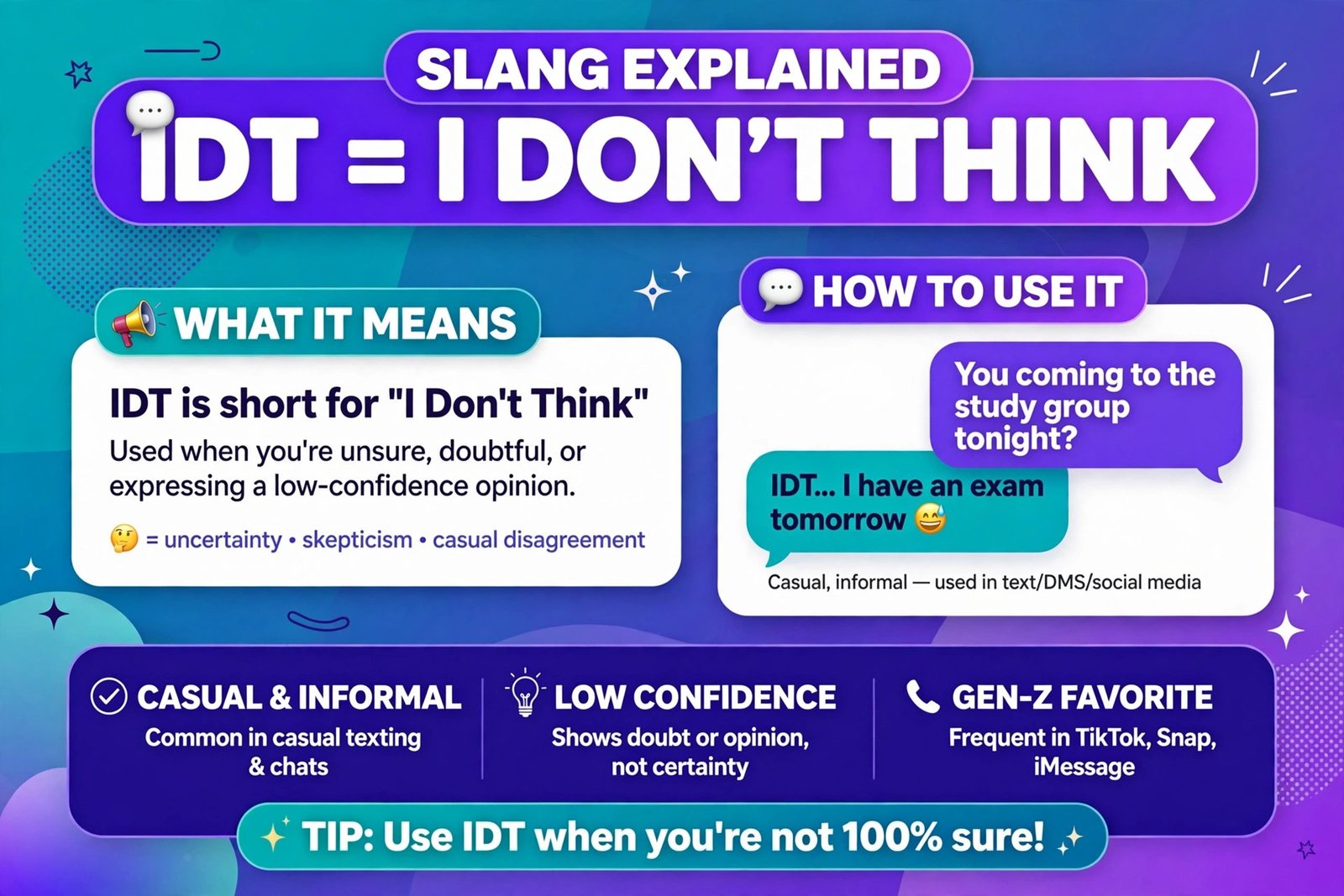

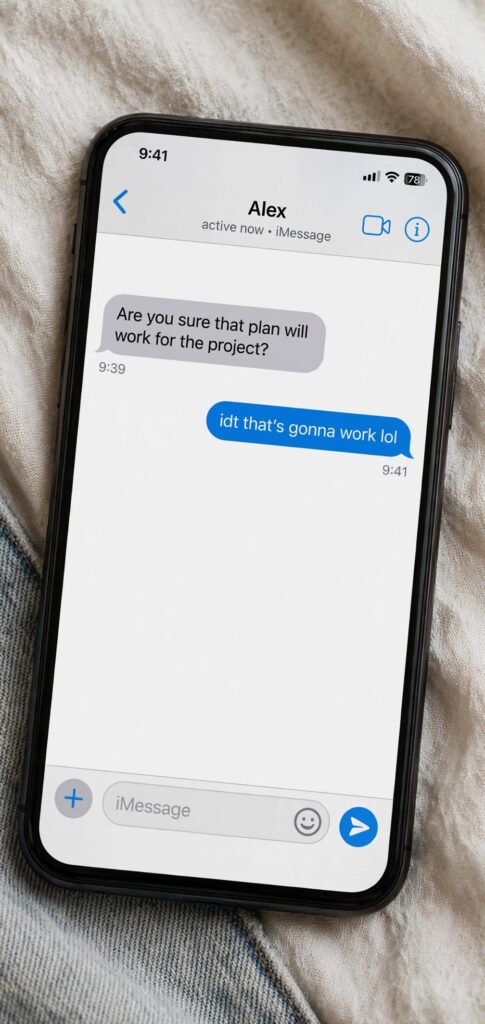
Seen “idt” in a text and wondered what on earth it meant? You’re not alone — it’s one of those abbreviations that looks like a typo until someone explains it. IDT stands for “I don’t think”, and once you know that, messages like “idt that’s gonna work” suddenly make perfect sense.
What Does IDT Mean in Text?
IDT is short for “I don’t think.” It’s texting shorthand — people compress the whole phrase into three letters.
- “idt that’s gonna happen lol”
- “idt he saw my message”
- “should I text him back?” — “idt 💀”
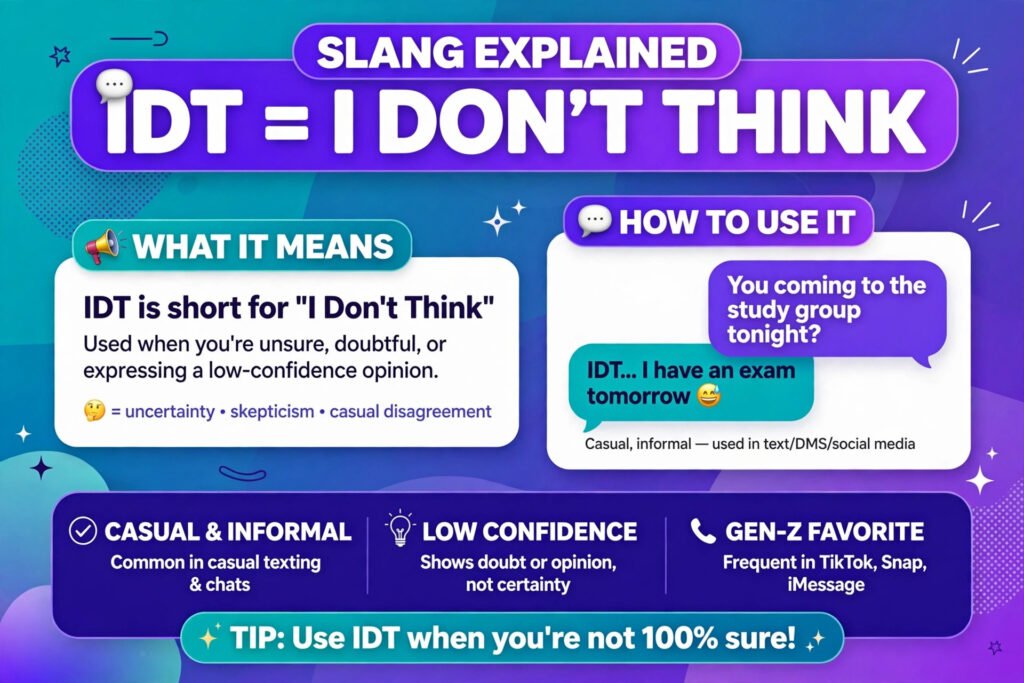
It’s a softer, more casual way of disagreeing or expressing doubt. Saying “I don’t think so” can sound blunt; “idt” keeps it light and low-pressure.
How People Use “IDT” in Texting
IDT shows up wherever quick, casual opinions fly:
- Soft disagreement: “that movie was amazing” — “idt 😅”
- Expressing doubt: “idt she’s coming tonight”
- Dodging plans politely: “wanna go out?” — “idt, I’m beat”
- TikTok comments: “idt this is real 💀” (on a suspicious video)
- Gaming chats: “idt we can win this round”
It’s almost always lowercase — “idt” not “IDT” — because it lives in the world of fast, informal typing. Capitalizing it would feel oddly formal for such a chill abbreviation.
Where Did “IDT” Come From?
IDT comes from the same texting tradition as its cousins idk (“I don’t know”) and idc (“I don’t care”) — the “I don’t ___” abbreviation family. These three-letter shortcuts were born in the SMS era when typing was slow and every character took effort.
The pattern is simple: take “I don’t think,” grab the first letters, done. Gen Z adopted it through group chats, DMs, and TikTok comments, where quick reactions matter more than perfect grammar. It’s the abbreviation equivalent of a shrug — casual, quick, and universally understood.
IDT vs IDTS — Don’t Mix Them Up!
Here’s the one confusion worth clearing up:
| Abbreviation | Means | Example |
|---|---|---|
| IDT | I don’t think | “idt that’s true” |
| IDTS | I don’t think so | “wanna go?” — “idts” |
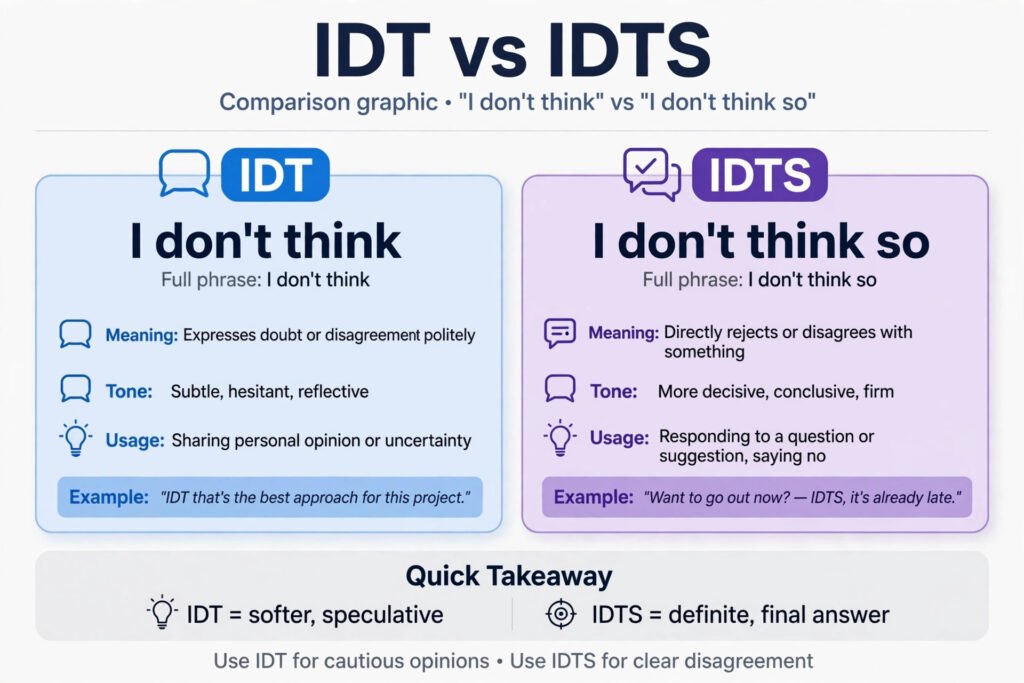
They’re close cousins. IDTS is the full “I don’t think so” — usually a direct answer to a yes/no question. IDT is shorter and looser — more of a general expression of doubt that can start or end a sentence.
In practice, people use them almost interchangeably. If someone replies “idts” to your plan, and you reply “idt either,” you’re both speaking the same language.
When Is It Okay to Use IDT?
IDT is perfect for:
- ✅ Texting friends and group chats
- ✅ TikTok comments and DMs
- ✅ Gaming chats and Discord
- ✅ Casual social media replies
And a bad idea for:
- ❌ Work emails or messages to your boss
- ❌ School assignments or formal writing
- ❌ Serious conversations where tone matters
It’s pure casual slang. With friends, “idt” sounds natural and relaxed; in a job interview, it sounds careless. Know your audience.
FAQs About IDT Meaning in Text
What is the full form of IDT in text?
IDT stands for “I don’t think.” It’s a texting abbreviation in the same family as “idk” (I don’t know) and “idc” (I don’t care).
How do you use IDT in a sentence?
Drop it in wherever “I don’t think” fits: “idt that’s gonna work,” “idt he saw my text,” or just “idt 💀” on its own.
What’s the difference between IDT and IDTS?
IDT means “I don’t think” (general doubt); IDTS means “I don’t think so” (usually answering a yes/no question). In practice they’re nearly interchangeable.
Is IDT rude or disrespectful?
Not at all — it’s just casual. It can sound dismissive in serious conversations, so save it for light, informal chats.
Where did IDT come from?
From SMS-era abbreviation habits — the “I don’t ___” family (idk, idc, idt). Gen Z kept it alive in group chats, DMs, and TikTok comments.
The Bottom Line
IDT is simply “I don’t think” in three letters — a tiny texting shortcut for “idt that’s gonna work,” “idt she’s coming,” and every casual doubt in between. Just don’t confuse it with IDTS (its “so”-carrying cousin), keep it out of formal writing, and you’re fluent. Happy texting! 💬

Zainab Ali is the founder and editor of Heart Puns, where she shares love puns, dad jokes, and easy-to-understand guides to text slang like FW, MBN, and ISTG. She loves turning everyday words into laugh-out-loud moments.
